Abstract
We present BioNFS (BioNFT Filesystem), a novel hybrid storage architecture that transforms centralized cloud storage (AWS S3) into a decentralized access control system through blockchain-native BioNFTs. By implementing BioNFTs as Decentralized Access Control Lists (DACLs), BioNFS provides genomic data governance comparable to enterprise Storage Area Networks (SAN) while adding cryptographic ownership, programmable licensing, and GDPR-compliant data erasure—capabilities impossible in traditional storage architectures or truly decentralized storage systems like IPFS.
Key Innovation: BioNFS represents the first filesystem architecture where data access is governed by NFT ownership rather than traditional ACLs, enabling "right to erasure" through NFT burning + S3 deletion while maintaining immutable audit trails of all access events on the blockchain. Genomic data remains in erasable centralized storage (S3), while access control is fully decentralized via blockchain smart contracts.
Critical Clarification: BioNFS is NOT decentralized storage—it converts centralized S3 buckets into NFT-gated vaults where ownership is decentralized but storage remains with AWS. This architecture is the ONLY GDPR-compliant solution for blockchain-based genomic data management, as true decentralized storage (IPFS, Arweave) cannot support "right to be forgotten."

Figure 1: The five-phase metamorphosis of a biosample from physical specimen to tokenized intelligence
1. BioNFS vs. Traditional Storage Area Networks
1.1 The SAN Parallel: Enterprise Storage Meets Blockchain
Storage Area Networks (SAN) have been the gold standard for enterprise data management since the 1990s. Brocade and Cisco fabric switches create high-performance, secure storage by implementing Fibre Channel zoning—essentially, hardware-enforced access control lists that determine which servers can access which storage LUNs.
🔐 Core SAN Concepts Applied to BioNFS
- Zoning (SAN) → BioNFT Ownership (BioNFS): Just as SANs zone storage to specific servers, BioNFTs zone genomic data to specific wallet addresses
- LUN Masking (SAN) → License Tokens (BioNFS): Granular access control through programmable licenses instead of static masks
- Fabric Switches (SAN) → Smart Contracts (BioNFS): Blockchain consensus replaces proprietary switching hardware
- Audit Logs (SAN) → Immutable Blockchain (BioNFS): Every access event permanently recorded on-chain
1.2 Comparative Architecture
| Feature | Traditional SAN (Brocade) | BioNFS (GenoBank) |
|---|---|---|
| Access Control | Hardware ACLs (Fibre Channel zoning) | BioNFT ownership + Smart contracts |
| Authentication | WWN (World Wide Name) verification | EIP-191 wallet signatures |
| Data Transport | Fibre Channel / iSCSI | QUIC over UDP (TLS 1.3) |
| Licensing | Static per-port licensing | Programmable IP Licenses (PIL) |
| Audit Trail | Syslog (mutable, centralized) | Blockchain (immutable, distributed) |
| Data Erasure | Delete files (often recoverable) | Burn NFT → automatic S3 deletion |
| Geographic Distribution | Expensive replication | Native multi-region support |
| Cost Structure | $50,000+ for enterprise fabric | Gas fees + S3 storage (~$0.023/GB/month) Ongoing AWS costs required |
| Governance | Centralized IT admins | Decentralized access control + Centralized storage Storage depends on AWS |
| Data Persistence | As long as company pays for hardware | As long as GenoBank pays AWS Same dependency as any cloud service |
1.3 Why Genomics Needs BioNFS, Not SAN
❌ SAN Limitations for Genomics
- No patient ownership - hospital controls everything
- No programmable licensing - all-or-nothing access
- No cross-institutional sharing without VPNs
- No GDPR "right to erasure" - data is never truly deleted
- No monetization - patients can't benefit from their data
✅ BioNFS Advantages
- Patient owns NFT, controls access cryptographically
- Programmable licenses with royalty streams
- Global sharing through blockchain
- GDPR-compliant erasure via NFT burning
- Patients earn from commercial data use
2. BioNFTs as Decentralized Access Control Lists (DACLs)
2.1 The Traditional ACL Model
Access Control Lists have been the foundation of computer security since the 1960s. Whether it's Unix file permissions (chmod 755) or Windows NTFS ACLs, the model is simple: a centralized authority maintains a list of who can access what.
2.2 BioNFT DACL Architecture
BioNFTs invert this model: instead of a central authority maintaining an access list, access rights are cryptographically provable through NFT ownership. The blockchain serves as the distributed, immutable access control database.
2.3 DACL Implementation: Story Protocol Integration
3. The Five Phases of Biosample Metamorphosis
A biosample's journey through GenoBank's microservices represents a metamorphosis from physical matter to authenticated intelligence. Each phase adds layers of computation, validation, and tokenization.
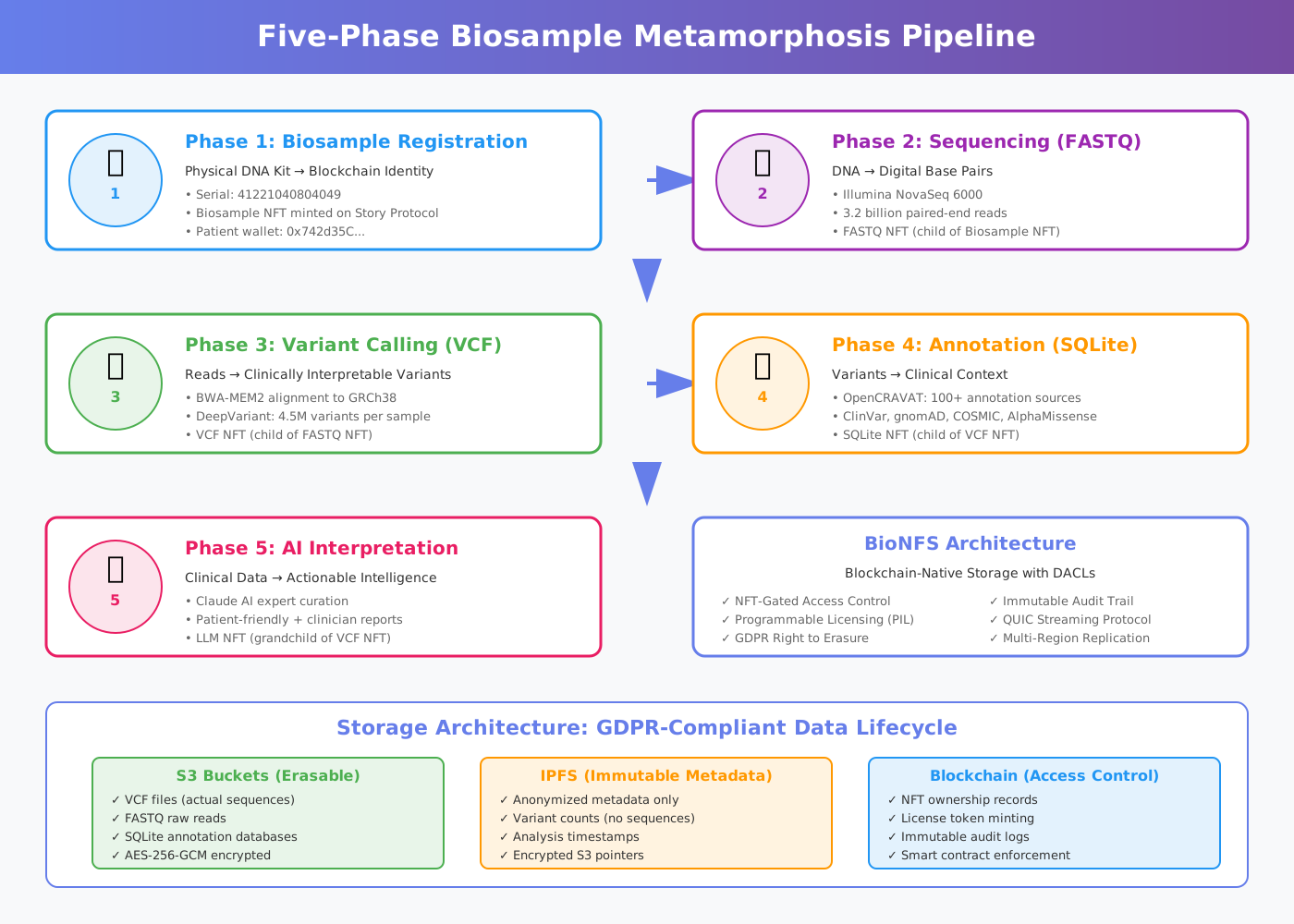
Figure 2: Complete metamorphosis pipeline from physical biosample to AI-analyzed intelligence
Phase 1: Physical Biosample → Digital Identity
Microservice: Biosample Registry (genobank.app/biosamples)
Transformation: Physical specimen receives blockchain identity
Technical Process:
- Activation: DNA kit serial number (99990000000002) registered on-chain
- Biosample NFT Minting: ERC-721 token created representing physical specimen
- Metadata Storage: Collection date, kit type, patient consent stored in MongoDB
- Blockchain Registration: Transaction recorded on Story Protocol
Phase 2: Sequencing → Raw Genomic Data (FASTQ)
Microservice: Clara Parabricks (clara.genobank.app)
Transformation: Physical DNA becomes digital base pairs
Technical Process:
- FASTQ Generation: Illumina NovaSeq produces 3.2 billion paired-end reads
- GPU Acceleration: NVIDIA Clara Parabricks processes on A100 GPUs
- Quality Control: >Q30 base quality, 30X coverage depth
- S3 Upload: Raw reads stored in encrypted BioNFT-Gated bucket
- Metadata NFT: FASTQ metadata minted as child of Biosample NFT
Sequencing Specifications:
- Platform: Illumina NovaSeq 6000
- Coverage: 30X whole genome (father, mother, proband)
- Read Length: 150bp paired-end
- Total Data: 3 × 90 GB FASTQ.gz per sample = 270 GB raw
- Processing Time: 18 hours GPU-accelerated
Phase 3: Variant Calling → Structured Genomic Information (VCF)
Microservice: Clara Parabricks DeepVariant
Transformation: Raw reads become clinically interpretable variants
Technical Process:
- Alignment: BWA-MEM2 aligns reads to GRCh38 reference genome
- Variant Calling: Google DeepVariant identifies SNPs and indels
- VCF Generation: Trio VCFs (father, mother, proband) with genotypes
- Trio Analysis: De novo mutation detection, inheritance patterns
- VCF NFT: Each VCF minted as child of FASTQ NFT
Outcome: 4.5 million variants per sample, ~120 de novo mutations per trio
Phase 4: Annotation → Clinical Context (SQLite + CSV)
Microservice: OpenCRAVAT (cravat.genobank.app)
Transformation: Variants gain clinical meaning through annotation
Technical Process:
- Clinical Databases: ClinVar, gnomAD, COSMIC, dbNSFP integration
- Pathogenicity Prediction: REVEL, CADD, AlphaMissense scores
- Gene Annotation: Functional consequence, protein impact
- SQLite Database: Comprehensive annotation results
- Annotation NFT: SQLite file minted as child of VCF NFT
| Variant | Gene | ClinVar | AlphaMissense | Interpretation |
|---|---|---|---|---|
| chr7:140753336 A>T | BRAF | Pathogenic | 0.92 (Likely Pathogenic) | V600E - Melanoma driver |
| chr15:48426484 C>T | FBN1 | Likely Pathogenic | 0.87 (Likely Pathogenic) | Marfan syndrome variant |
| chr1:11796321 G>A | MTHFR | Benign | 0.12 (Likely Benign) | Common polymorphism |
Phase 5: AI Interpretation → Actionable Intelligence
Microservice: Claude AI (claude.genobank.app)
Transformation: Clinical data becomes patient-understandable insights
Technical Process:
- Expert Curation: Claude AI analyzes annotated variants
- Clinical Report: Natural language interpretation for clinicians
- Patient Report: Simplified explanations for families
- Treatment Recommendations: Evidence-based therapeutic options
- LLM NFT: AI-generated report minted as grandchild of Annotation NFT
Claude AI Report Example:
For Clinician:
"The proband carries a de novo heterozygous BRAF V600E mutation (NM_004333.4:c.1799T>A, p.Val600Glu) with 0.92 AlphaMissense pathogenicity score. This variant is well-established as an oncogenic driver in melanoma. Given the de novo nature and high pathogenicity, consider dermatological monitoring and genetic counseling."
For Patient:
"Your child has a new genetic change in the BRAF gene that wasn't inherited from either parent. This change is associated with an increased risk of skin cancer (melanoma) later in life. We recommend regular skin checks with a dermatologist starting in adolescence. This doesn't mean your child will definitely develop cancer, but awareness allows for early detection if needed."
4. Technical Implementation: BioNFS Architecture
4.1 System Components
4.2 BioFS CLI - The User Interface to BioNFS
The BioFS command-line tool provides direct access to the BioNFS network:
4.3 MCP Server - AI Agent Integration
The Model Context Protocol server exposes BioNFS to AI agents like Claude:
MCP Resources Exposed:
@bionfs:bioip://0xBioIPID- BioIP asset discovery@bionfs:vcf://trio_99990000000002- VCF file metadata@bionfs:license://0xLicense7- License verification
Example AI Agent Usage:
5. GDPR Compliance: Right to Erasure via NFT Burning
Traditional filesystems cannot truly delete data—forensic recovery is always possible. BioNFS implements cryptographic erasure through NFT burning, making data mathematically inaccessible.
5.1 The Decentralized Storage Problem: Why IPFS Fails GDPR
Why IPFS Cannot Be Used for Genomic Data
- Immutability: IPFS content is permanent and cannot be deleted
- No Erasure Support: GDPR Article 17 "Right to Erasure" is impossible—once data is on IPFS, it can be pinned by anyone globally forever
- Public Distribution: Data replicates across thousands of nodes with no central control
- GDPR Violation: Using IPFS for personal genomic data is illegal in EU—there is NO compliant decentralized storage solution
- The Reality: True decentralized storage (IPFS, Arweave, Filecoin) fundamentally conflicts with "right to be forgotten"
5.2 BioNFS Solution: NFT-Gated Centralized Storage with Decentralized Access Control
Key Insight: BioNFS does NOT make storage decentralized—it makes access control decentralized while keeping genomic data in GDPR-compliant erasable S3 buckets.
🔐 BioNFS Architecture Reality Check
- Storage Layer: AWS S3 (fully centralized, GenoBank pays AWS monthly)
- Access Control: BioNFTs on blockchain (fully decentralized)
- GDPR Compliance: Burn NFT → S3 files immediately deleted → data erased
- Cost Model: ~$0.023/GB/month S3 storage + gas fees for NFT operations
- Single Point of Failure: If GenoBank stops paying AWS, data is lost (same as any cloud service)
✅ What's On Blockchain (Immutable)
- BioNFT ownership records
- License token metadata
- Access audit trail (who accessed when)
- Anonymized statistics (variant counts, no sequences)
- S3 path references (encrypted, not genomic data)
✅ What's in S3 Buckets (Erasable)
- VCF files (actual genomic sequences)
- FASTQ raw reads
- SQLite annotation databases
- Clinical reports
- All personally identifiable data
- Can be deleted when BioNFT is burned
5.3 Erasure Implementation
6. Real-World Use Cases
🏥 Clinical Research
Scenario: Multi-hospital rare disease study
- Patients own their BioNFTs
- Grant research licenses to 5 institutions
- Automatic royalties for commercial drug development
- Can revoke access at any time
🧬 Precision Medicine
Scenario: Family trio analysis for de novo mutations
- Parents own trio BioNFTs
- License to genetic counselor
- AI analyzes inheritance patterns
- Results tokenized as grandchild NFT
📊 Pharma Drug Discovery
Scenario: Genomic data marketplace
- Patients list BioNFT licenses for sale
- Pharma companies purchase access
- Smart contract enforces royalties
- Immutable audit of all data access
🤖 AI Model Training
Scenario: Training AlphaMissense-style models
- Aggregate access via DAO voting
- Privacy-preserving federated learning
- Attribution to all data contributors
- Model NFT inherits licenses from training data
7. Future Directions
7.1 Emerging Technologies
Bloom Filters
Privacy-preserving genomic membership queries without exposing variants. Unlike zKPs, bloom filters work efficiently with non-deterministic variant data for set membership testing.
Homomorphic Encryption
Compute on encrypted genomic data without decryption
Decentralized Compute
Federated variant calling across institutional boundaries
7.2 Cross-Chain Interoperability
BioNFS currently operates on Story Protocol (EVM-compatible). Future work includes:
- Cross-chain BioNFT bridges (Ethereum ↔ Polygon ↔ Avalanche)
- Multi-chain license verification
- Cosmos IBC integration for healthcare networks
8. Conclusion
BioNFS represents a pragmatic solution to the genomic data sovereignty problem—not through pure decentralization, but by decentralizing access control while keeping data in GDPR-compliant erasable storage. By implementing BioNFTs as Decentralized Access Control Lists over centralized S3 buckets, we've created the ONLY blockchain-based architecture that respects "right to be forgotten."
The Hard Truth: True decentralized storage (IPFS, Arweave, Filecoin) fundamentally conflicts with GDPR Article 17. BioNFS accepts this reality and builds a hybrid architecture: blockchain governs who can access, while AWS S3 stores what is accessed. This dependency on AWS is not a limitation—it's a requirement for legal compliance.
The five-phase metamorphosis of biosamples through GenoBank's microservices demonstrates that genomic data is not static—it evolves from physical matter to authenticated intelligence, with each transformation adding value and creating new opportunities for research, treatment, and patient empowerment.
Key Contributions:
- Hybrid Architecture: First system to combine centralized storage with decentralized access control for genomics
- GDPR Compliance: Right to erasure through NFT burning → S3 deletion (impossible with IPFS)
- BioNFT DACLs: NFT-based access control replacing traditional filesystem ACLs
- Biosample Metamorphosis: Five-phase journey from specimen to intelligence
- Privacy Technology: Bloom filters for variant membership queries (not zKPs—variants aren't deterministic)
- Cost Transparency: ~$0.023/GB/month S3 + gas fees (no hidden decentralization costs)
As genomic data becomes increasingly central to healthcare, BioNFS provides the infrastructure to ensure that patients maintain sovereignty over their genetic information while respecting GDPR requirements. The architecture proves that decentralization doesn't mean storing data on IPFS—it means decentralizing control while keeping data where it can be legally deleted.
References
- Story Protocol. "Programmable IP Protocol for Digital Assets." https://story.foundation
- Quinn Project. "QUIC Transport Protocol Implementation." https://github.com/quinn-rs/quinn
- GDPR Article 17. "Right to erasure ('right to be forgotten')." EU General Data Protection Regulation.
- Pagel KA, et al. (2020). "Integrated Informatics Analysis of Cancer-Related Variants." JCO Clinical Cancer Informatics.
- Google DeepVariant. "Highly accurate genomic predictions with deep neural networks." Nature Biotechnology, 2018.
- NVIDIA Clara Parabricks. "GPU-Accelerated Genomics Analysis Toolkit." https://www.nvidia.com/en-us/clara/parabricks/
- GenoBank.io. "Web3 Infrastructure for Genomic Data Ownership." https://genobank.io
- Model Context Protocol. "Standard protocol for AI-application integration." https://modelcontextprotocol.io
- Bloom BH. "Space/time trade-offs in hash coding with allowable errors." Communications of the ACM, 1970. (Foundation for privacy-preserving genomic queries)
- Benet J. "IPFS - Content Addressed, Versioned, P2P File System." arXiv:1407.3561, 2014. (Why it fails GDPR for genomic data)
Get Started with BioNFS
Experience the future of genomic data storage:
- BioFS CLI:
biofs --help - MCP Server: https://genobank.app/api_biofs_node/mcp
- BioNFS Documentation: https://docs.genobank.app/bionfs
Contact: daniel@genobank.io | GitHub: github.com/Genobank/BioNFS